

Master Web Development & Build Stunning Websites!
Want to become a professional web Development? Join Job Point’s Web Development Course and master the latest technologies used in front-end and back-end development.
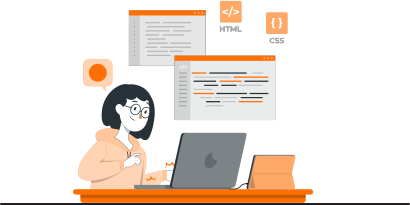
Want to create dynamic, interactive, and professional websites? Join Job Point’s Web Development Course and master the latest technologies used in front-end and back-end development.
Front-end development focuses on building the user-facing part of websites and web applications. It involves using HTML, CSS, and JavaScript to create the layout, design, and interactive elements that users see and interact with directly in their browser.

HTML (HyperText Markup Language) is the foundational language used to create the structure of web pages. It organizes content using elements like headings, paragraphs, images, and links, acting as the skeleton of a webpage.

CSS (Cascading Style Sheets) is used to style and visually design HTML content. It controls layout, colors, fonts, and overall presentation, making websites attractive and user-friendly.
JavaScript is a powerful programming language that enables interactive features on web pages. It allows developers to create dynamic content, handle user input, and update pages in real-time without reloading.
🚀 Together, HTML, CSS, and JavaScript form the core technologies of web development, enabling the creation of structured, styled, and interactive websites.
Choosing the right and industry-experience CRM development partner can make a huge difference in how efficiently your business operates. Here's why companies & businesses rely on us:
Node.js is an open-source, cross-platform runtime environment that allows developers to run JavaScript on the server side. Built on Google’s V8 JavaScript engine, Node.js is known for its speed, scalability, and event-driven, non-blocking I/O model. It enables the development of fast and scalable network applications, making it a popular choice for building RESTful APIs, real-time applications, and backend services.

Express.js is a minimal and flexible Node.js web application framework that provides a robust set of features for building web and mobile applications. It simplifies the process of building server-side applications by providing tools to handle routing, middleware, and HTTP requests/responses.

PHP (Hypertext Preprocessor) is a widely-used open-source server-side scripting language designed for web development. It is especially suited for creating dynamic web pages and can be embedded into HTML. PHP powers many major websites and is supported by nearly all web servers and hosting providers.

Laravel is a modern, elegant PHP web application framework that follows the MVC (Model-View-Controller) architectural pattern. It simplifies and speeds up web development by providing built-in tools and features like routing, authentication, caching, and database management through Eloquent ORM.
Database Management refers to the process of storing, organizing, and managing data using specialized software called a Database Management System (DBMS). It ensures that data is easily accessible, secure, consistent, and efficiently handled.

MySQL is an open-source relational database management system (RDBMS) used to store, manage, and retrieve data efficiently. It uses SQL (Structured Query Language) for accessing and manipulating databases and is widely used in web applications alongside technologies like PHP, HTML, and JavaScript.

PostgreSQL is a powerful, open-source object-relational database management system (ORDBMS) known for its reliability, flexibility, and advanced features. It supports SQL for querying and procedural languages for custom functions, making it ideal for complex, enterprise-level applications.
Cloud Hosting and Deployment are key components of modern web and software development.
Git is a free, open-source version control system that tracks changes in code and allows multiple developers to work on the same project without overwriting each other’s work. It helps manage source code history and facilitates collaboration.
GitHub is a cloud-based platform built on top of Git. It provides a web interface for hosting and managing Git repositories, offering additional features like pull requests, issue tracking, and collaboration tools.
🚀 Together, Git and GitHub are essential tools in modern software development workflows.
Cloud Hosting uses a network of remote servers (the cloud) to store, manage, and deliver websites and applications. It offers scalability, flexibility, and high reliability by distributing resources across multiple servers. Popular providers include AWS, Google Cloud, and Microsoft Azure.
eployment is the process of releasing an application from development to a live environment where users can access it. In cloud environments, deployment is often automated, allowing for faster updates, easier scaling, and better performance.
🚀 Together, cloud hosting and deployment make it easier to build, launch, and manage applications efficiently and reliably.





9 to 12 months (Flexible learning options)

Online & Offline Available

Find nearby training center
📢 Start Your Web Development Journey & Build Amazing Websites!